Deadly Train Crash
Experts believe that a faulty rail joint could be crucial in uncovering the reasons behind one of Spain’s most devastating railway disasters in recent years. Tragically, at least 40 lives were lost and 159 people were injured in a high-speed collision between two trains on Sunday.
The Sky News Data & Forensics team is here to break down how this horrific crash unfolded. Before the incident, a train operated by the private company Iryo, carrying around 300 passengers, left Malaga on its way to Madrid at 6:40 PM (5:40 PM GMT).
Meanwhile, the other train, managed by Spain’s public train service Renfe and carrying nearly 200 people, departed from Madrid heading to Huelva at 6:05 PM local time (5:05 PM GMT).
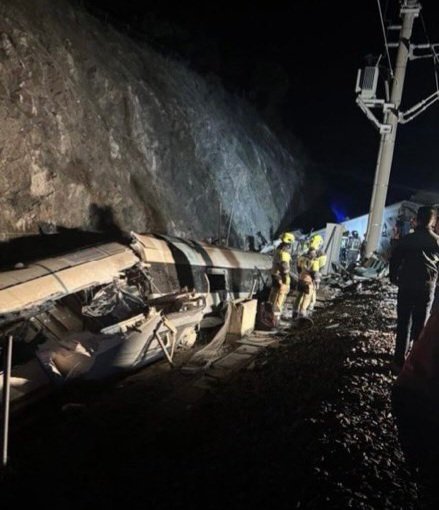
Then, around 7:45 PM local time (6:45 PM GMT), the rear of the first train, traveling from Malaga to Madrid, derailed and veered onto the opposite side of the tracks.
It collided with the other train near Adamuz, a town in the province of Cordoba, located about 230 miles south of Madrid. At the moment of impact, both trains were racing along at speeds exceeding 120 mph.
Footage captured the chaotic scene as passengers scrambled out of shattered windows following the crash, with emergency services rushing to assist.
Those injured were quickly transported to a nearby hospital.
Spain’s transport minister, Oscar Puente, stated that the cause of the crash remains unclear, describing it as “a truly strange” occurrence since it took place on a flat section of track that had just been renovated in May.
He explained that the back of the Iryo train had derailed, veering onto the opposite track and colliding with the front of the Renfe train, which caused its first two carriages to topple off the track and tumble down a four-meter slope.
The most significant damage was sustained by the front section of the Renfe train, he noted.
Mr. Puente also shared an image of the system used to monitor the infrastructure and the movement of all trains across the network.
The map displayed the live positions of the two trains nearly two hours after the crash, with red lines indicating that the track was blocked.
A preliminary investigation has pinpointed a faulty joint as a significant factor in the train crash, according to a report from Reuters, which cited an insider.
The news agency noted that technicians discovered some wear on the joint connecting sections of the rail, referred to as a fishplate, indicating that the issue had likely been present for a while.
Ian Prosser, the former chief inspector of railways, mentioned that the derailment was probably caused by a track-related problem, like a broken rail.
“The most probable scenario would be some sort of track fault or an issue with the train itself,” he explained. “However, that would be quite unusual.”
Mr. Prosser also pointed out that high-speed train accidents on straight tracks, like this one, are quite rare.
“It takes a considerable amount of time for a train to come to a complete stop,” he added. “So, at that speed, it would continue traveling for quite a while after the initial impact.”
Earlier, Alvaro Fernandez Heredia, the president of Spain’s national railway company Renfe, stated that “human error could be ruled out.”
The Iryo train, which was built in 2022, had its last inspection on January 15 of this year.
The track where the crash happened was also newly renovated, having undergone a complete overhaul last May, with a hefty investment of €700 million (£607 million).
Despite this, there were still concerns, as a Spanish train drivers’ union had warned the rail operator Adif about significant wear and tear on the tracks, including the one involved in the collision, in a letter sent last August.
In October of last year, rail unions even reached out to the government to ask for a speed reduction on the line to help prevent accidents.
Deadly Train Crash