Uganda opposition alleges rigging
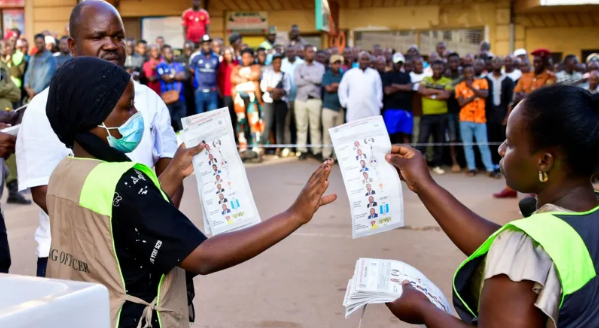
Votes are currently being tallied in various regions of Uganda, all while the internet is down and opposition leaders are raising alarms about potential rigging in the presidential and parliamentary elections.
“There’s massive ballot-stuffing happening everywhere,” tweeted presidential candidate Bobi Wine, although he didn’t provide any evidence to back up his claims.
The authorities have yet to address his accusations of electoral fraud, nor have they responded to his assertion that “many” polling agents and supervisors from his NUP party were “abducted, and others were chased away from polling stations.”
Delays of up to four hours have been attributed to malfunctioning biometric machines that are supposed to verify voters’ identities.
Some people are connecting these issues to the internet outage, along with a shortage of voting materials and equipment that didn’t arrive at some stations on time.
As a result, polling stations ended up closing later than expected. The electoral commission has stated that anyone who was in line by 17:00 local time (14:00 GMT) was allowed to cast their vote.
Earlier today, the electoral agency issued an apology for the “technical glitches” and assured everyone that officials were actively working to fix the issues.
In the presidential race, Yoweri Museveni, who has been in power since 1986 and is now 81 years old, is aiming for his seventh consecutive victory against Bobi Wine, a dynamic 43-year-old pop star.
The electoral commission has announced that the results of the presidential vote will be revealed by 16:00 local time (13:00 GMT) on Saturday.
Voting wrapped up by 18:00 local time at the polling stations in Kampala that the BBC visited, despite some delays.
While we haven’t seen any turnout data yet, it seems that some voters may have left without casting their ballots.
On the other hand, many were eager to make their voices heard, and there was a palpable sense of frustration over the morning’s issues.
“I’m really upset because I still haven’t voted. We were supposed to start at seven, but here we are at [08:00] and nothing has happened. The ballot papers aren’t even here, and I honestly don’t know what to say,” shared Kaweesi Ismail, a voter in Kampala, with the BBC.
Election chief Simon Byabakama has instructed that the national voters’ register be used in places where the biometric machines failed to work.
The issues seem to have impacted both regions that are seen as pro-government and those believed to be strongholds of the opposition.
While casting his vote in his hometown of Rwakitura Village in the western Mbarara region, President Museveni shared that he faced some challenges too.
“I placed my thumb on the machine, but it didn’t register. However, my face was recognized right away. The machine is functioning,” he remarked.
When asked if he would accept the election results, the president responded, “This is one of the manipulations – we need to investigate why this happened and what the issue was.”
“We’re currently checking to see if this was intentional,” he added.
The presidential election is essentially a contest between Museveni and Wine, but with Museveni having won the last six elections, analysts suggest he’s likely to extend his rule even further.
Wine has vowed to combat corruption and implement significant reforms, while Museveni claims he is the only one who can ensure stability and progress in the nation.
The campaign period has been overshadowed by disruptions to opposition activities, with security forces accused of assaulting and detaining supporters of Wine.
Police spokesperson Kituuma Rusoke dismissed these allegations, accusing supporters of Wine’s National Unity Platform (NUP) party of causing disturbances.
Internet access was cut off on Tuesday, with Uganda’s Communications Commission stating that the blackout was essential to curb misinformation, fraud, and violence incitement. This decision has drawn criticism from the UN human rights office, which called it “deeply worrying.”
The National Unity Platform (NUP) has dismissed this rationale, accusing the regulator of attempting to hinder the opposition’s ability to mobilize and share evidence of election fraud. In response, the party has rolled out an offline vote-monitoring app to use in case of future blackouts.
The app, named Bitchat, leverages Bluetooth technology to transmit images of results forms from polling stations and voting data without needing internet access, as explained by Wine.
Yoweri Museveni, a former guerrilla army leader, has benefited from two constitutional amendments that eliminated age and term limits, enabling him to continue running for office.
Wine, whose real name is Robert Kyagulanyi, lost to Museveni in the 2021 elections, but he has rejected the results, claiming they were fraudulent.
This year, alongside Museveni and Wine, six other presidential candidates will appear on the ballot.
Voters will also be selecting a new parliament, with 353 seats available.
For many casting their votes on Thursday, the economy is the primary concern.
With the majority of the population under 30, even though average incomes are gradually increasing, there simply aren’t enough jobs to meet the demands of all the young people seeking employment.
Uganda opposition alleges rigging